Thought leaders in every industry are making their predictions as to how 2026 will pan out, and the life sciences is no exception. Read on for forward-looking insights into clinical planning, patient recruitment, clinical trial disclosure, and more.
Darcy Grabenstein
Director of Content Strategy and Thought Leadership
View profile

Director of Content Strategy and Thought Leadership
Citeline
Darcy is the Director of Content Strategy and Thought Leadership for Citeline. A journalist by training, she has more than 30 years of experience in marketing, advertising, and public relations.

Throughout the industry, there is a clear push for earlier and cleaner evidence, says Izabela Chmielewska, Citeline Managing Editor, Custom Content. Teams want to make confident decisions sooner, she says, which is driving tighter study designs and a stronger focus on what can be learned in the first stages of development.
In addition, she says community-based research is moving from small pilots to something sponsors are willing to build into their core strategy. The priority now is proving that it strengthens timelines, retention, and data quality in a reliable way.
Controlled models also are gaining attention, Chmielewska notes, because they offer clarity at a point where field trials can be unpredictable. They help teams refine programs before they commit to larger, more expensive studies.
Another trend Chmielewska sees is that trial design is becoming more pragmatic. Sponsors are thinking more carefully about what is realistic for patients and what supports sites, and that shift tends to produce smoother studies with clearer data.
Citeline Manufacturing Editor Andrew Warmington predicts contract development and manufacturing organizations (CDMOs) will become more focused on long-term partnership and full-service offerings, with increased investment in novel modalities. He adds that small molecules should remain dominant as first-line treatments.
Izabela Chmielewska
Editor-in-Chief, Custom Content
View profile

Editor-in-Chief, Custom Content
Citeline
Izabela is an experienced writer and editor with a robust background in B2B journalism. Currently, at Citeline, she produces custom content across various mediums and platforms, focusing on pharmaceutical and biotechnology news and insights. She is responsible for creating partnered content and Norstella thought leadership. She collaborates closely with commercial teams to develop topical themes and content solutions that resonate with clients. Additionally, she manages the creation and moderation of live sponsored webinars and in-person roundtables, as well as writing new content such as articles, whitepapers, research reports and conducting interviews with SMEs.
Andrew Warmington
Manufacturing Editor
View profile

Manufacturing Editor
Citeline
Andrew Warmington has been writing about pharmaceuticals and related industries since becoming editor of Speciality Chemicals Magazine in 2002. His particular area of expertise is in the C(D)MO drug substance and CRO markets, plus some on the regulatory side developed during an 18-month stint with Chemical Watch. During this time, he has attended every CPhI Worldwide plus other key industry events, such as Informex/CPhI North America, DCAT Week and PharmaChem Outsourcing, where he has been a regular moderator of expert panels. He has also been a freelance proof-reader within the industry, notably for a major drug packaging company. Andrew has a PhD in History, and speaks French and Spanish, plus just enough Italian to get by. In his spare time, he is a would-be true crime writer, a TV quiz veteran and a sad cricket fan who would happily hibernate when the season is over…

Matt Holms, Citeline VP of Sales for Patient Engagement & Recruitment, sees a couple of major trends taking hold in 2026. First, sponsors will leverage both data and AI for comprehensive patient matching. More specifically, they will combine real-world data (RWD) and proprietary data with tokenization and AI to locate hard-to-find patients.
Second, he cites the integration of data as “the foundational continuum for feasibility as well as patient recruitment. Successful recruitment doesn’t start once the study starts,” he says. “It begins at protocol design/site selection.”
Matt Holms
VP of Sales, Patient Engagement & Recruitment
View profile

VP of Sales, Patient Engagement & Recruitment
Citeline
Matt Holms is the VP of Sales responsible for overseeing Patient Engagement & Recruitment Solutions at Citeline. He has spent 24 years in the Life Science industry, holding various commercial & executive leadership roles, dedicated to driving innovative technology solutions that enhance clinical research across a diverse spectrum of eClinical technology, Patient Recruitment/RWD, and Sponsor organizations. Beyond his professional endeavors, he is passionate about patient access and awareness of clinical research opportunities, having personally experienced life-changing results and benefits as a clinical research study participant.

Jake Mathon
Senior Manager
View profile

Senior Manager
Citeline
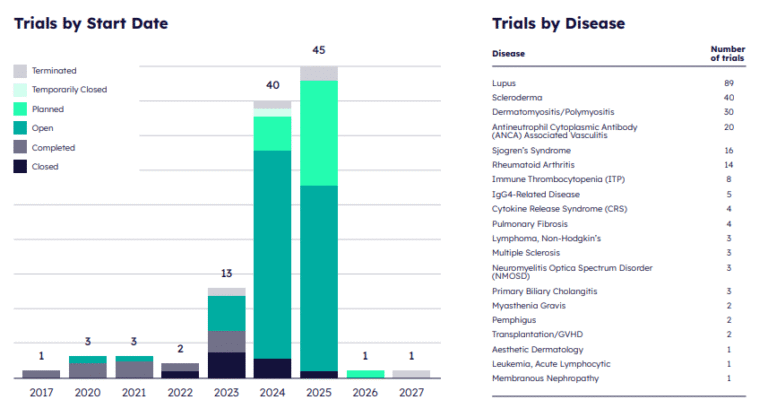
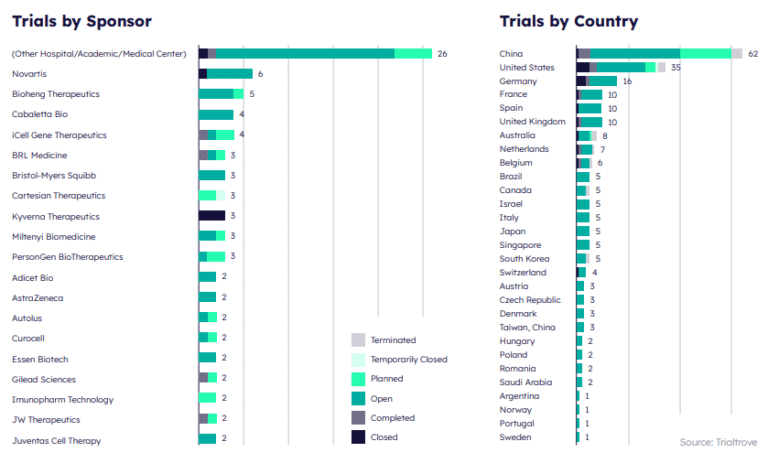
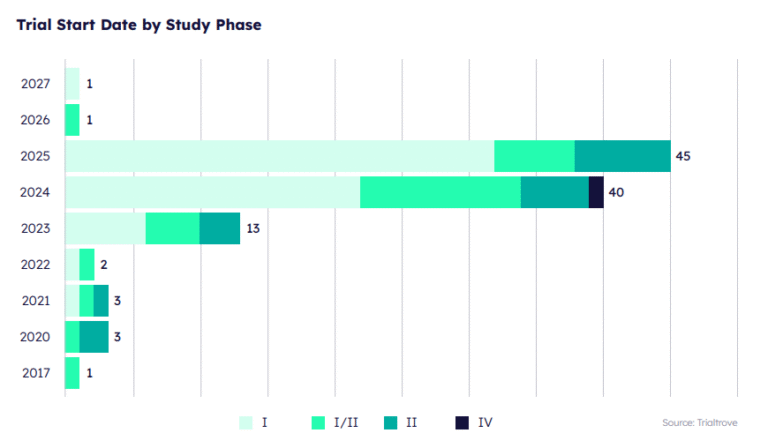
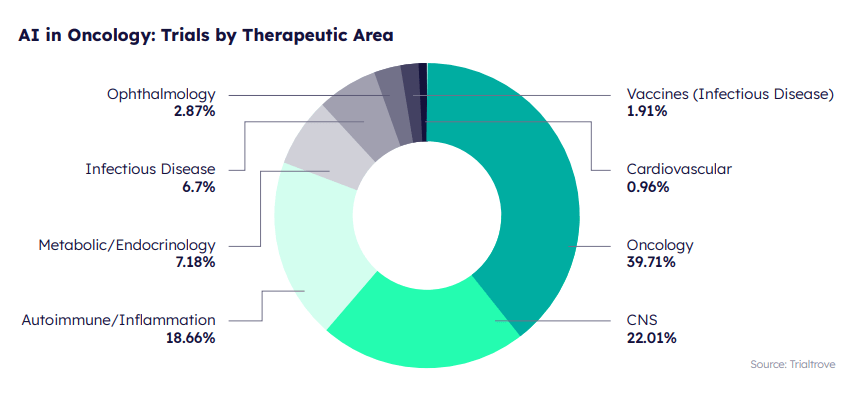
Based on Trialtrove data, it appears likely that the recent upward trend will continue for clinical trials in autoimmune diseases involving chimeric antigen receptor T cell (CAR-T) therapy.
Heidi Chen, Citeline Associate Director, Research & Commercial Support, says, “We wouldn’t be seeing lots of trials populating in 2026 and 2027, because these are planned and completed trials. The number of trials will increase as we progress into these years.” She adds that sponsors report trials at a later date, creating a lag in the data.


Many of these autoimmune diseases fall into the rare disease category, which is poised for an uptick in research. “In 2026, I’m confident that the number of clinical trials for rare diseases will continue to increase,” says Wes Michael, President and Founder, Rare Patient Voice. “Orphan drugs are now exempt from several negative provisions of the [US] Inflation Reduction Act, and many expect the FDA to be more favorable in regulating rare disease drugs.”
Heidi Chen
Associate Director, Research & Commercial Services
View profile

Associate Director, Research & Commercial Services
Citeline
Heidi Chen supports client engagement with Citeline content through a deep understanding of customer business needs, seasoned expertise in proprietary platforms, market analysis, and commercial activities. She oversees Citeline's production of customized Platinum Datapacks across hot topic facing industry today.
Heidi draws from her pharmaceutical industry experience as a drug discover scientist and over two decades of therapy-area expertise in CNS, immunology, and ophthalmology. Within this remit, she collaborates across various functional groups within Citeline, and contributes towards projects such as consulting engagements, webinars, and thought leadership white papers.

Wes Michael
President and Founder
View profile

President and Founder
Rare Patient Voice

The International Council for Harmonisation (ICH) updated its Good Clinical Practice (GCP) guideline, effective as of July 23, 2025. According to Claire Riches, Citeline VP of Clinical Solutions, the pharmaceutical industry’s overall data and AI strategy actually lines up very closely with what the updated ICH GCP E6(R3) is pushing for: risk-proportionate, data-driven, tech-enabled trials with much stronger data governance and oversight.
Riches says the industry’s move to shared data products and integrated platforms in 2026 is essential to meeting these expectations — central data assets and AI services can be governed, validated, and audited more consistently than fragmented local tools.
In short, Riches says, if pharma uses 2026 AI and data investments to strengthen quality by design (QbD), risk-based quality management (RBQM), centralized monitoring, and data governance — rather than to “black box” decisions — those strategies will be highly compatible with, and in many cases enabled by, ICH GCP E6(R3).
Claire Riches
VP, Clinical Solutions
View profile

VP, Clinical Solutions
Citeline
Claire brings more than three decades of clinical operations and development experience across pharma, biotech and CROs. She joined Norstella in 2024 and oversees solution consulting teams across Citeline, guiding the creation of both bespoke and off-the-shelf clinical solutions. Her role runs in two directions: tailoring solutions for customers, and making sure the voice of the customer shapes what product teams build and how it reaches the market. Increasingly that includes custom services for clients who need a tailored answer rather than a product.
Francine Lane, Citeline Head of Transparency, points out that the UK Medicines for Human Use (Clinical Trials) (Amendment) Regulations 2025 goes into effect in April 2026, so that will be a major focus for those conducting trials there. She says these requirements correspond more closely with the Good Clinical Practice guidance and the Declaration of Helsinki than others. “It’s an ethical framework, not just a compliance checkbox,” she says. “I think there will be a broader trend to register and provide summary results for all trials conducted in humans, at least by the time that the product reaches approval.”
Lane says this aligns with what Jennifer Miller and Bioethics International is doing with the Good Pharma Scorecard. “Even when regulations haven’t caught up,” she says, “there’s growing momentum towards transparency as an ethical imperative. The question of ‘Should I register this trial?’ is being replaced by ‘Yes, of course this trial will be registered.’”
Ben Evans, Citeline Disclosure Regulations Research Manager, predicts that ISRCTN will increasingly become the preferred “go-to” registry for international clinical trials in 2026, potentially overtaking ClinicalTrials.gov in usage outside the US. ISRCTN is a registry following requirements set out by the World Health Organization (WHO) International Clinical Trials Registry Platform (ICTRP) and the International Committee of Medical Journal Editors (ICMJE) guidelines. The US government shutdown had disrupted ClinicalTrials.gov operations, causing registration delays for non-US-required studies, while ISRCTN actively promoted its availability and implemented platform enhancements to accommodate increased submission volumes.
Francine Lane
Head of Transparency
View profile

Head of Transparency
Citeline
Francine Lane is Senior Director of Product at Citeline and former chair of the Drug Information Association (DIA) Clinical Trial Disclosure Community. Francine is responsible for helping TrialScope Disclose and TrialSummaries.com customers meet and exceed current disclosure expectations globally, giving them the tools they need to satisfy the requirements in this evolving industry. Francine also dedicates her time building relationships with external stakeholders — including sponsors, investigators, regulators, and transparency and patient advocates — to help align the goals and expectations of these groups, as well as help identify more consistent ways sponsors can meet transparency expectation and requirements.

Ben Evans
Disclosure Regulations Research Manager
View profile

Disclosure Regulations Research Manager
Citeline
Ben Evans leads the development and evolution of TrialScope Intelligence, a global clinical trial regulatory intelligence platform that delivers high-quality, actionable content to help clients navigate complex disclosure regulations. His role combines research, strategy, and cross-functional collaboration, working closely with regulatory experts, product, tech, and commercial teams to ensure alignment with client needs and company goals.
Data quality is becoming the real test for new digital and analytical tools, says Citeline’s Chmielewska. Regulators want clarity about how data are collected and handled, and sponsors are far more selective about the datasets they choose to rely on.
Kemi Williams, a senior executive in clinical research & population health, says companies will evolve from broad, awareness-style diversity efforts to hyperlocal, data-driven strategies that incorporate social determinants of health, geospatial insights, and real-world evidence to identify where unmet need truly lies. Incomplete or non-representative datasets, she says, undermine confidence among patients, providers, payers, and regulators.
Kemi Williams
Senior executive in clinical research & population health
View profile

Senior executive in clinical research & population health

Moving into 2026, Catalano says, “AI and ML will continue to help reshape how we understand and treat cancer, potentially revolutionizing trial design and patient outcomes.”
In the regulatory realm, Citeline’s Evans predicts that AI-powered tools for intelligent content parsing, automated document analysis, and multilingual translation will become increasingly adopted by registries globally, streamlining registration workflows and reducing manual data entry burdens for researchers.
“AI is obviously going to have a big impact on disclosure and regulatory,” Citeline’s Lane says. “Sponsors and vendors are all experimenting with AI for content generation — plain-language summaries, registry authoring, and even protocol development, which indirectly influences disclosure quality. There’s also interest in using AI to interpret regulatory requirements.
“But I’ll be honest,” she continues, “the technology isn’t reliable enough yet to operate without human oversight. AI-assisted writing is improving quickly, but you absolutely need someone reviewing the output to catch errors or nonsensical content. It’s a powerful tool, but it requires expert judgment to use effectively.”
David Wild, Senior Reporter at Citeline’s In Vivo, says, “We’re moving past the potential of AI and skepticism into actual data and partnerships, with companies beginning to show real results in drug discovery and start-ups locking in deals by building highly specialized datasets for drug discovery.
“The next wave of AI includes virtual cells and digital twins that will, with increasing accuracy, mimic individual patient biology, along with federated learning initiatives that are breaking down data silos to create larger, more useful datasets. AI-based trial optimization is gaining traction with the promise of reducing patient recruitment numbers, accelerating recruitment, and cutting failure rates. However, given the long drug development timelines, it will still take time to see if these tools truly deliver more effective drugs faster and cheaper.”
While Chmielewska agrees that AI is important in R&D, she emphasizes that data quality is integral for AI systems and integration to flourish.
Domenique Catalano
Senior Manager
View profile

Senior Manager
Citeline
David Wild
Senior Reporter
View profile

Senior Reporter
In Vivo
David’s reporting since 2001 has focused on the clinical aspects of medicine, particularly in the American health system. He’s covered everything from novel drugs for inflammatory bowel disease (think back to the advent of biologics!) to protocols for fine-tuning use of anticoagulants post-operatively, and from the fallout of medication compounding disasters to regulatory concerns about the 340B drug pricing program. He has covered dozens of medical conferences and profiled numerous clinicians and institutions. David is a native of Israel and lives in Toronto, Canada. His hobbies include playing music, gardening, camping and spending time with his wife, son and mini-Bernedoodle, Moishe.