Optimize clinical trial design in one connected workflow.

Validate I/E criteria against real populations, benchmark every protocol choice against 60,000+ curated trials, and cut the amendments that slow recruitment before they happen.
AMENDMENT RISK POPULATION MATCH 70% match Real-world patients Protocol Design Workbench ELIGIBILITY CRITERIA Age 18–75, confirmed diagnosis ECOG performance status 0–1 ! No prior systemic therapy POPULATION MATCH 70% of real-world patients qualify Feasibility confirmed

Built for better protocol planning

Trial Design brings together the industry’s most comprehensive clinical trial dataset, advanced analytics, and AI-assisted workflows, helping teams move faster and plan with greater certainty.
''

Design protocols that recruit

Build studies around the patients who exist today, not the ones you hope will appear once the trial goes live.

''

Back decisions with evidence

Support eligibility criteria, endpoints, and timelines with evidence from historical trials and real-world data.
''

Avoid costly surprises

Identify recruitment and feasibility risks before they become amendments, delays, and missed milestones.
The Clinical Intelligence Platform

See how protocol decisions affect feasibility, sites, and recruitment

Trial Design runs on Citeline’s single, unified data layer spanning the full spectrum of clinical development, so every result and recommendation stays consistent and grounded in the industry’s best data.
Core Data & APIs AI-ENABLED RECOMMENDATIONS PATIENT INTELLIGENCE Clinical Landscape Site Selection Patient Recruitment Trial Design

Clinical Landscape

See the full competitive picture across pipelines and assets.

Trial Design

Design protocols real patients can qualify for and complete.

Site Selection

Place trials where the right patients and capable sites meet.

Patient Recruitment

Reach the right patients at the right moment.

Why it matters

The real cost of designing without patient evidence

Without real patient and site evidence at the design stage, recruitment problems surface only after the protocol is finalized, showing up as amendments, missed timelines and empty sites.

Spent by sites on feasibility assessments and qualification visits in 2024

$ 0 0M

of Phase I–IV protocols undergo at least one amendment

0 %

Median direct cost of a substantial Phase II or III protocol amendment

$141K- 0 K

approved sites under-enroll, while 11% enroll no patients

1 in 0
Source: Tufts Center for the Study of Drug Development research on feasibility, protocol amendments and site performance.
Trial Design in practice

What you can do with Trial Design

Design protocols around real patient populations

Test eligibility criteria against real-world patient populations before the protocol is finalized.

  • Validate eligibility criteria against real-world patient populations
  • Understand the impact of each criterion on patient availability
  • Evaluate feasibility across countries, regions, and sites

Strengthen protocol decisions with evidence

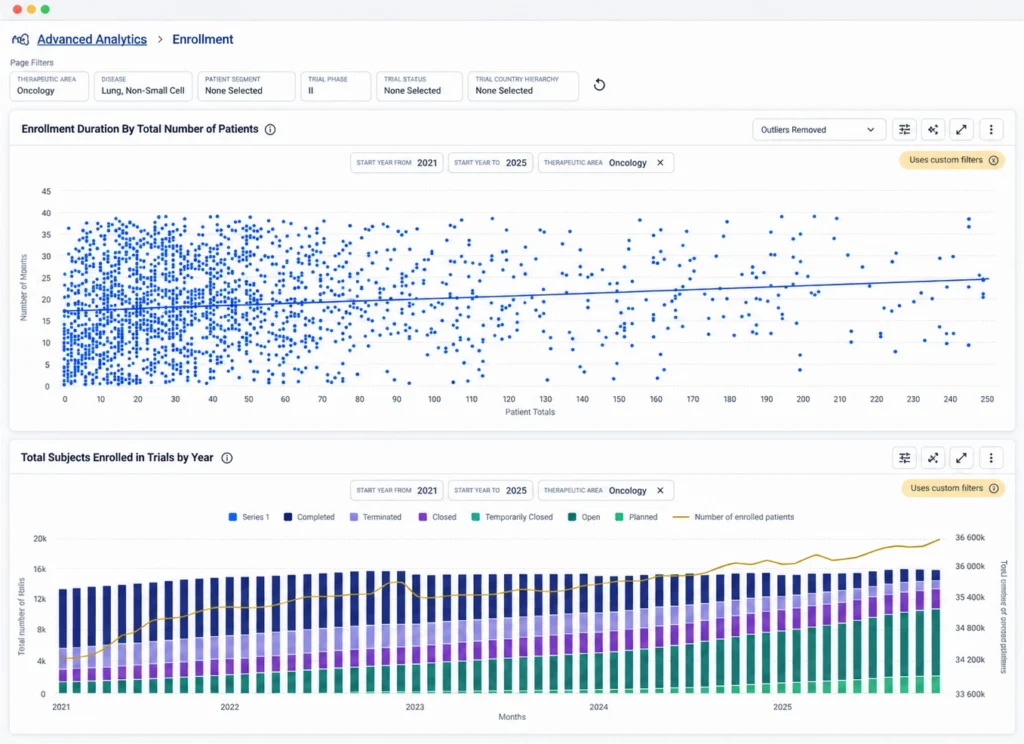
Compare endpoints, eligibility criteria, timelines, and enrollment performance across successful trials.

  • Benchmark against 60K+ curated trials
  • Compare endpoints, enrollment, and amendments
  • Generate AI-assisted protocol recommendations

Identify recruitment and feasibility risks earlier

Evaluate enrollment trends, competitive activity, and emerging risks across comparable studies.

  • Compare enrollment performance across similar trials
  • Monitor competing studies and pipeline activity
  • Reduce amendment risk from the start
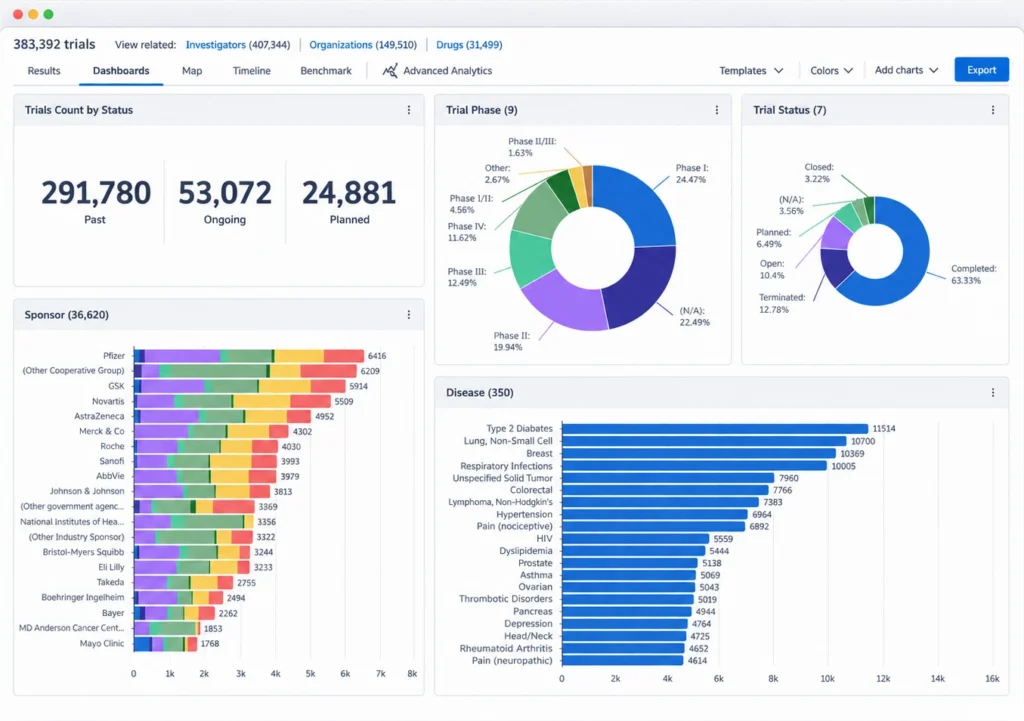
Product dashboard featuring various charts and graphs with different data about clinical trials and their statuses.
Products & Data

Explore the products behind the workflow

Clinical intelligence, patient data, and AI-powered applications working together in one connected workflow.
Patient intelligence

Understand the patients behind the protocol

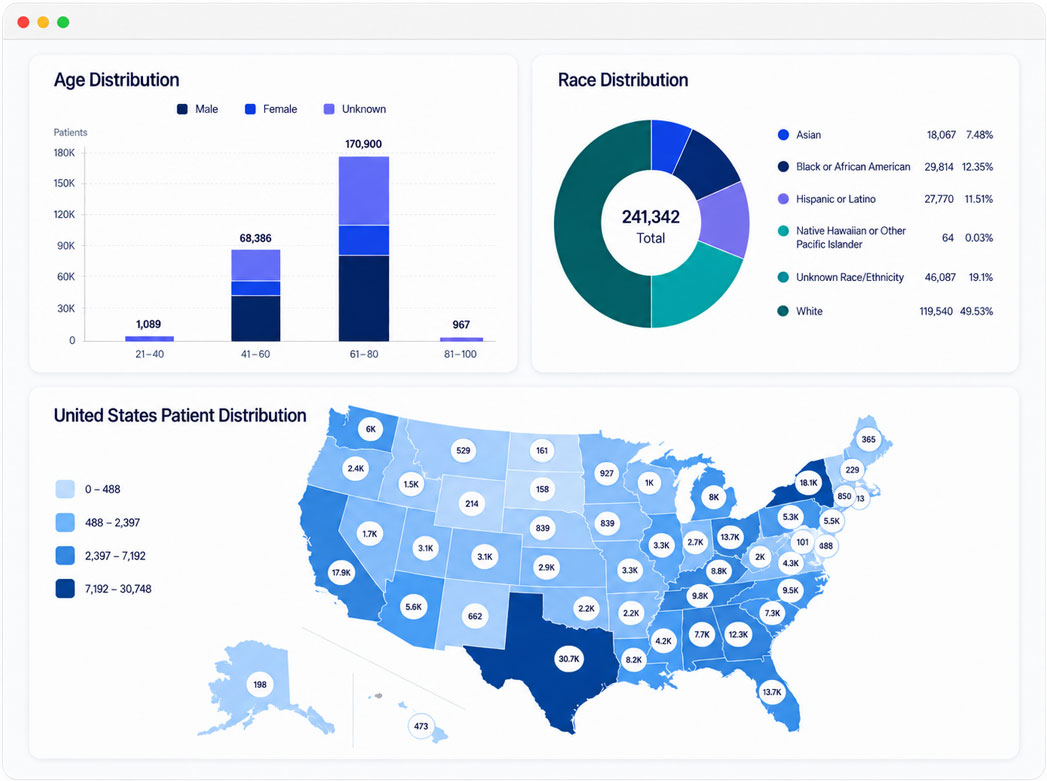
Trial success starts with the patient. Patient Intelligence combines epidemiology, standard of care, and real-world patient journey data to show where patients are, how they’re treated, and which providers care for them, helping teams design studies around real-world clinical reality.

''

Eligible patient population

Understand how many patients meet your study requirements.
Real-world care patterns

See how patients move through diagnosis, treatment, and referral.

''

Feasibility insights

Identify risks earlier and make more informed protocol decisions.

Proof

Built on intelligence you can trust

Every recommendation is built on the industry’s most complete clinical intelligence foundation, curated by expert analysts and strengthened with AI.

Curated trials

0 K+

Sites across 185 countries

0 K+

Years of clinical intelligence

0 +

Validated accuracy

0 %+
''

Expert-validated, human-led

Analyst-curated intelligence, not raw aggregation. AI supports decisions while your team stays in control.

''

Unmatched proprietary data

57%+ more coverage than ClinicalTrials.gov, drawn from sources no public registry captures.

''

Clinical intelligence at scale

30+ years of analyst-curated trial, site, and patient intelligence.

How it compares

From siloed analysis to connected decisions

Design protocols around real patient populations, benchmark against what works, and evaluate feasibility earlier, all within one connected workflow.
The Traditional Approach The Trial Design Workflow
Trial, patient, site and competitive intelligence reviewed separately Trial, patient, site and competitive intelligence connected in a single workflow
Eligibility criteria designed first, recruitability validated later Eligibility criteria evaluated against real patient populations during design
Feasibility assessments built through multiple manual analyses Feasibility informed continuously throughout protocol development
Recruitment risks often discovered after launch Recruitment risks identified earlier in planning
Decisions rely heavily on expert judgement and fragmented evidence Decisions supported by patient intelligence, clinical data and AI-assisted recommendations
See it in action

See the workflow in action

Pricing

Speak with our team about how Trial Design fits your clinical planning process

FAQ

Frequently Asked Questions

Trial Design helps sponsors and CROs design more recruitable protocols, benchmark against historical trials, and evaluate feasibility earlier.
Trial Design brings together Trialtrove, Sitetrove, Patient Intelligence, APIs, and AI-powered SmartSolutions in a single workflow. Product availability varies by package.
Trial Design uses Patient Intelligence to show how protocol decisions affect real-world patient availability, treatment patterns, and feasibility.
Yes. Cohort SmartBuilder helps teams evaluate how eligibility criteria affect the size and characteristics of the recruitable patient population.

By identifying recruitment and feasibility risks earlier, Trial Design helps teams make better-informed protocol decisions before study launch.

Protocol authoring tools help teams write protocols. Trial Design helps teams evaluate, benchmark, and optimize protocol decisions before they are finalized.
Yes. Trial Design benchmarks endpoints, eligibility criteria, enrollment performance, and timelines against comparable trials using Trialtrove intelligence.
Get started

Speak to the Trial Design team

Tell us where your protocol is today and we’ll show you the fastest path to a design real patients can complete.

This site is registered on wpml.org as a development site. Switch to a production site key to remove this banner.