
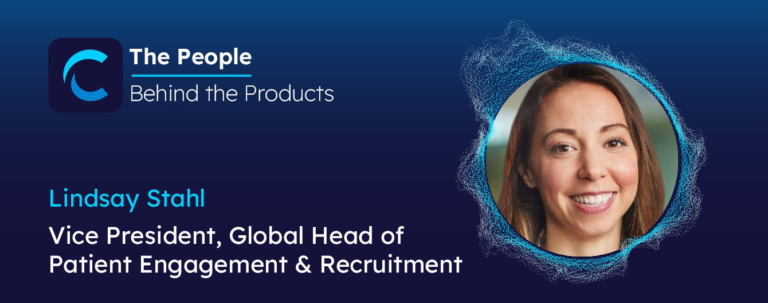
I lead the operations and delivery team within our Patient Engagement & Recruitment (PE&R) function. My team manages and delivers creative product solutions across the PE&R suite, including some of the biggest growth drivers within Norstella, our parent company. We work closely with product, commercial, and real-world data [RWD] teams to ensure our deliverables meet both client expectations and market needs in the recruitment space. We also operationalize new third-party partnerships that enhance the performance and utility of our solutions. It’s a dynamic role, and I genuinely enjoy it.
My background is rooted in science. I spent several years in academia working in behavioral neuroscience labs through graduate school, then transitioned to Merck as a scientist in early stage preclinical drug development. Being close to discovery has always been a core motivator for me, and that role was a natural fit. Over time, though, I wanted to apply my work at a larger scale, to move beyond animal models and into research with broader human impact so I went back to school for epidemiology and entered the population health and data space.
My first role after that program was at a health system in New York City, where we developed an EMR [electronic medical record] querying tool. It gave study sites and physicians direct access to patient data and supported investigator-initiated trials. I led the educational governance for the product, co-developed and taught a course on it, and helped expand data access across the institution. We talk about “democratizing data” constantly now, but this tool was genuinely doing that before the concept was as popularized as it is now.
Later I joined TriNetX [a strategic partner of Norstella], a company with broad clinical trial capabilities and a large global data ecosystem. I led their US healthcare partnership team, managing relationships with the healthcare organizations contributing data to the network. That deepened my understanding of how data can power the clinical trial ecosystem.
When I came to Norstella, I started on the real-world data delivery side, supporting data projects for life science customers. I met Suzanne Caruso, Citeline’s General Manager of Clinical & Regulatory, and soon switched over to Citeline. Seeing what was happening in the PE&R space, I’ve never looked back.
Without question, it’s my team. Watching them grow into strategic, articulate, deeply knowledgeable project managers is genuinely one of the privileges of this role. There’s something special about guiding someone and then watching them reach a point where they no longer need that guidance. Recently, a project manager framed a client presentation in a way that had strategic implications well beyond that single project — it was a proud moment.
I love solving complex, cross-functional problems. When an issue is affecting multiple teams, I want to be in the middle of it, understanding the full picture, and working toward a resolution that lifts the burden for everyone involved. Those are the problems with the greatest impact and, because my team works cross-functionally by nature, I get to tackle them often.
Overall my team and I are involved in highly fit-for-purpose approaches to recruitment and have a suite of solutions to support clinical studies. We’re also involved in the operationalization of a new product, Citeline TrialMatch, including its go-to-market strategy. Citeline TrialMatch is a publicly accessible platform that allows patients to discover clinical trials they may be eligible for. There’s no sign-in required to get started — patients simply interact with a chatbot, enter some basic information about themselves, and can preview relevant trials right away.
If a patient wants to match to a specific trial, they create an account, set their communication preferences, and optionally sync their electronic medical record. We extract relevant data points to ensure accurate trial matching. It’s a meaningful step forward in making trial access simpler and more patient-friendly.
Natural language processing is already playing a significant role, particularly in applying large language models to unstructured data to surface clinically relevant information faster and more accurately. This reduces the need for manual review, accelerates project delivery timelines, and speeds up the assessment of patient eligibility. Ultimately, it’s about getting patients access to potentially life-saving therapies sooner.
But AI’s impact goes deeper than processing speed. Tools like Citeline PatientMatch show what’s possible when you combine AI with real-world data which is drawn from sources like electronic medical records, claims, and labs. Rather than waiting for patients to find a trial, we can proactively identify candidates who are genuinely likely to be eligible, before they’ve ever raised their hand. That shifts the entire recruitment model from reactive to proactive.
This matters especially at the bottom of the funnel, where patient drop-off is one of the most persistent challenges in clinical trial recruitment. When AI-driven matching happens upstream, the patients arriving at sites are better qualified and far more likely to enroll.
Staying active with my family is a big priority. We’re a ski family in the winter, and I spend as much time outdoors as possible — hiking, running, and heading to the beach in the warmer months. We travel often together, internationally when possible, and plan our vacations around those activities. I also practice yoga and am actually a certified instructor, though I haven’t taught in a few years.
When I’m not outside, I’m almost certainly baking … bread, cookies, cakes, pies, you name it. Something comes out of my oven just about every week. And any remaining time tends to be spent following my 8-year-old son to his travel hockey games. Anyone who’s been a hockey parent knows exactly what that commitment looks like!